

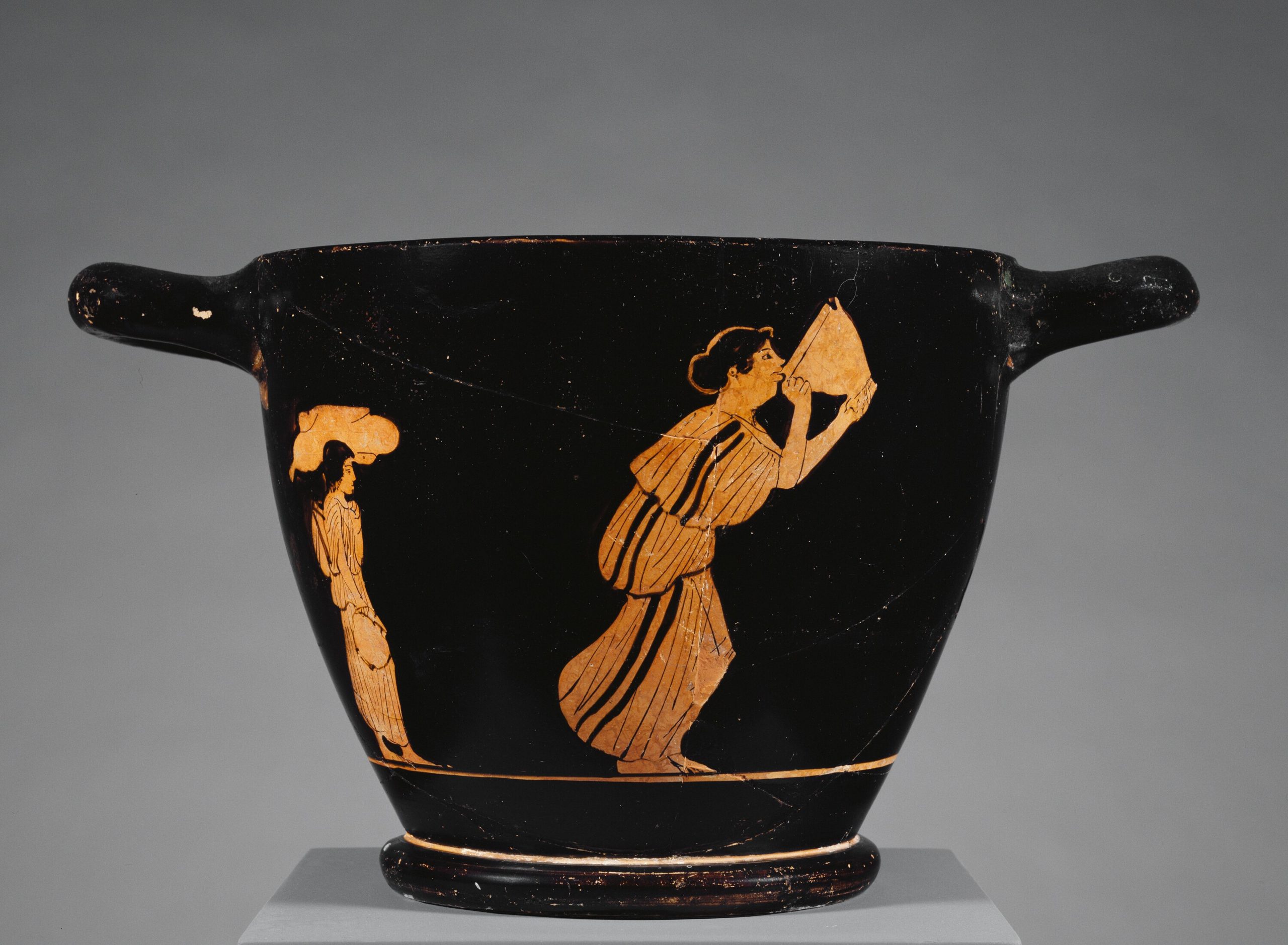
Holding a piece of ancient pottery in hand can give one a sense of power. Be it a freshly excavated fragment still covered in dirt, a whole or partial vessel from remote site storage, or a figure-decorated specimen pulled from public display in a museum, it is the feel of the fabric that one recalls after the fact. Is it soapy or smooth? Is the surface texture rough, irregular, or grainy? One also remembers the size and shape. Is it small enough to hold in the palm of your hand (fig. 1)? Or are both hands required to move and manipulate it (figs. 2-3)? Regardless of the scale or quality of pottery, as with other artifacts, it is touching the material object that often proves key to the interpretive process in archaeology.
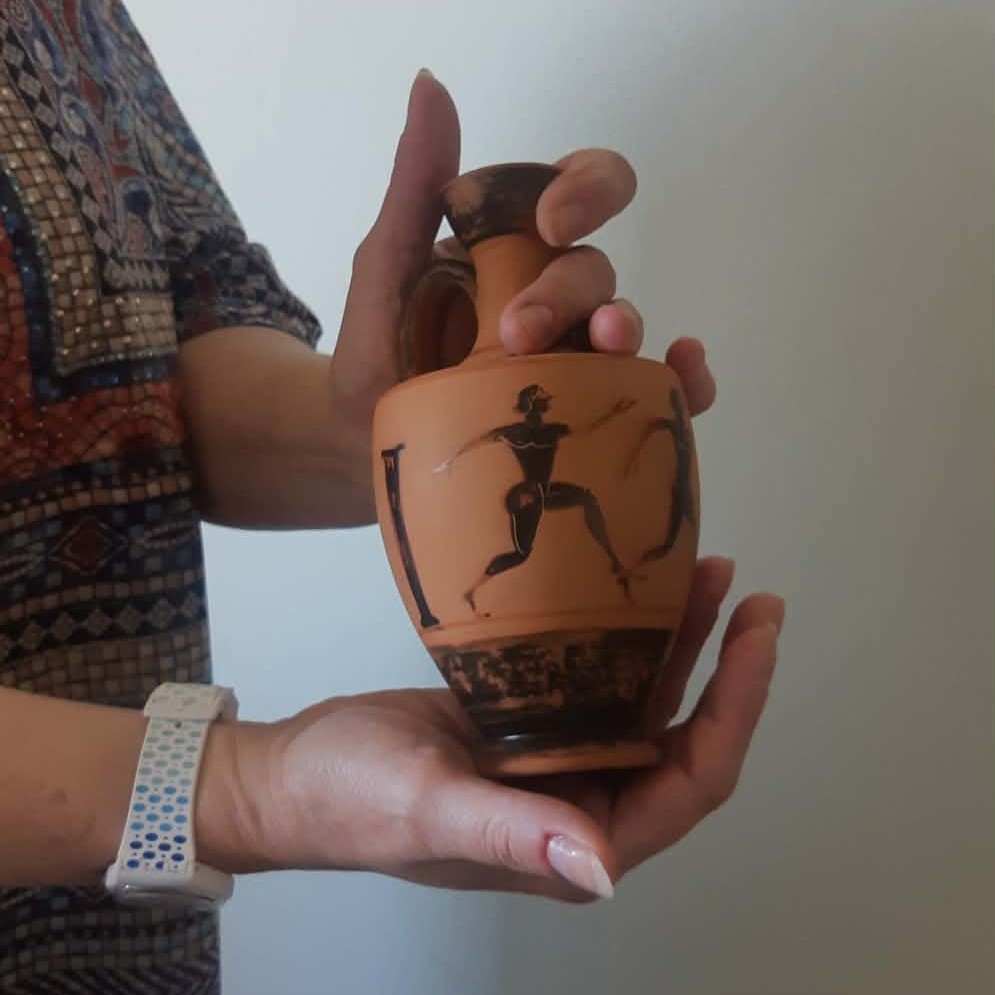
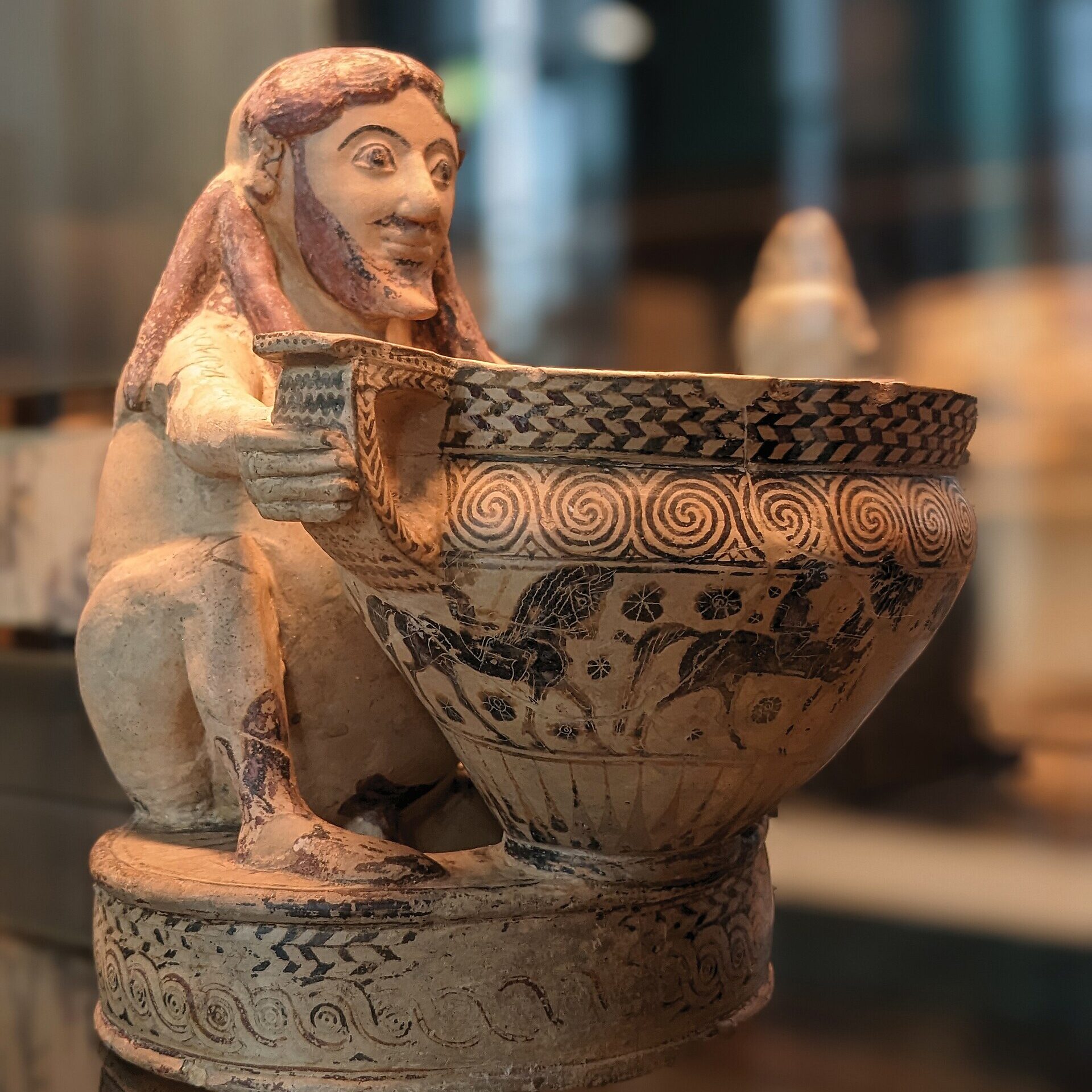
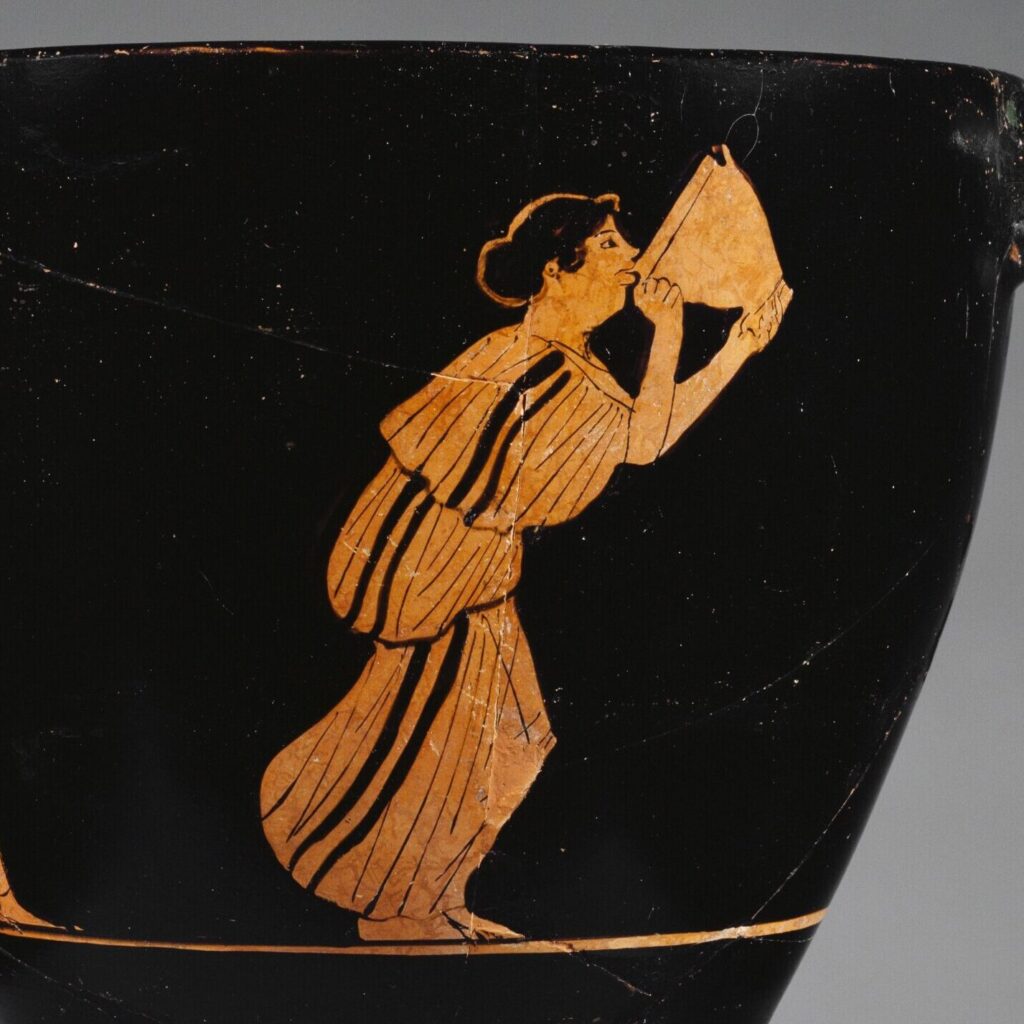
Ancient Greek pottery, or ‘vases,’ play a unique role in this conversation. Produced during the 6th and 5th centuries BCE at a variety of locations across the Greek world, these decorated vessels can be set apart from other pottery traditions due to the exceptional scenes of gods, humans, animals, and objects on their surfaces. Embedded in displays of dancing and drinking, athletics and worship are the ancient vases themselves: cups, aryballoi, amphorae, and other shapes put into practice before our very eyes. Take the example of an early 6th-century BCE Corinthian black-figure vessel in the three-dimensional shape of a bearded reveler or ‘komast’ (fig. 2). On a break from his normal dance routine, he clutches a large stemless decorated drinking cup (skyphos) or mixing bowl (krater), both shapes associated with the consumption of wine, the god Dionysos, and the symposion. By comparison, on an Athenian red-figure skyphos of ca. 450 BCE a woman sneaks into the storeroom and brings a big skyphos to her lips using both hands (fig. 3). Together these two rather different ancient examples are potent reminders that, despite any modern associations with the term ‘vase,’ back in the day pottery served a variety of uses and functions. Across various settings and occasions, these ancient vase-handlers are demonstrating ways such objects were touched and held, used and experienced.
The act of touching pottery, like any ancient artifact, also has demonstratable pedagogical advantages. Yet real ancient Greek vases are often inaccessible to the students and scholars who study them. As a result, the springboard of much vase research is the decoration, viewed as a sort of window into the past. However, 3D technologies such as digital scanning and printing can grant access to and engagement with these objects, thus reaching a wider audience of students, scholars, and others. Communication using the sense of touch, known as haptics, has already been recognized as a pathway to understanding the visual and material aspects of antiquity (Purves 2017; Malafouris and Loukouti 2022). Its applications in digital archaeology have been considered as part of the process of 3D-recording objects by comparing the experience of modern models (digital or printed) with their ancient originals (Jamil et al. 2018; fig. 4). Both approaches have been used at the University of Virginia (UVA), where I have converted my own undergraduate and graduate seminars into a series of roving learning laboratories. As part of the 3D Greek Vase Scanning and Printing Project (3D-GV) project at UVA, for the past decade students of archaeology, classics, studio art, art history, and architecture have gathered in the classroom to learn pottery drawing and painter attribution; at the library to become familiar with the research principles used in the study of Greek vases; at the Fralin Museum of Art to learn techniques for scanning vases in the collection (fig. 5); and at the School of Engineering to learn techniques, materials, and applications of 3D-printing in the context of a research laboratory. 3D-GV was practically born by accident when a generous student over a decade ago presented me with a 3D-printed Panathenaic amphora in miniature – a touching gesture that forever changed my thinking about Greek vases and their haptic potential.
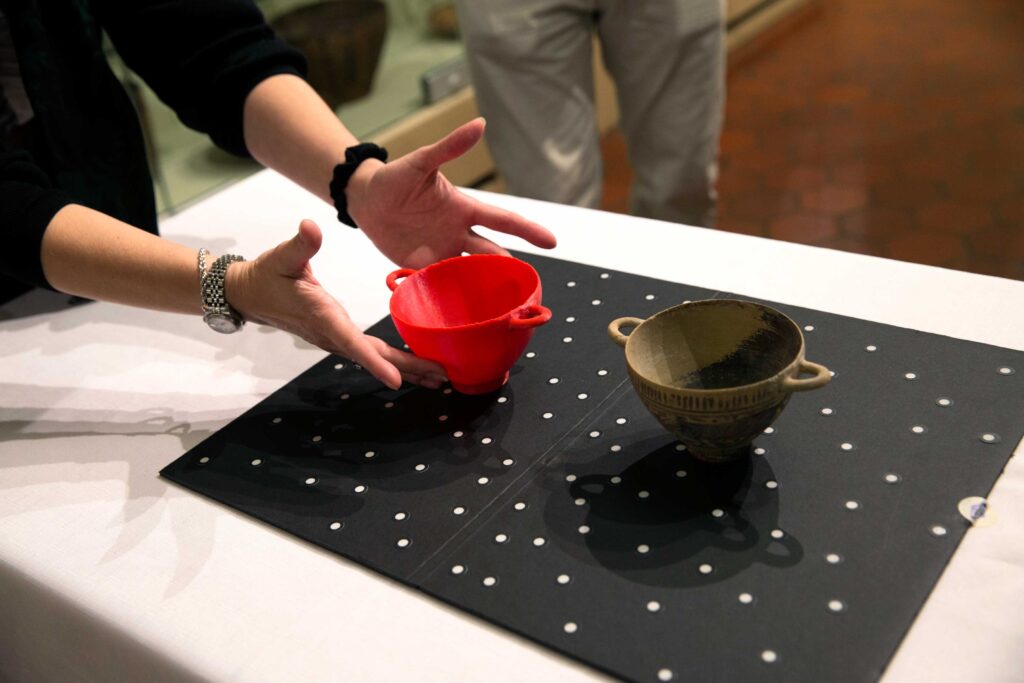
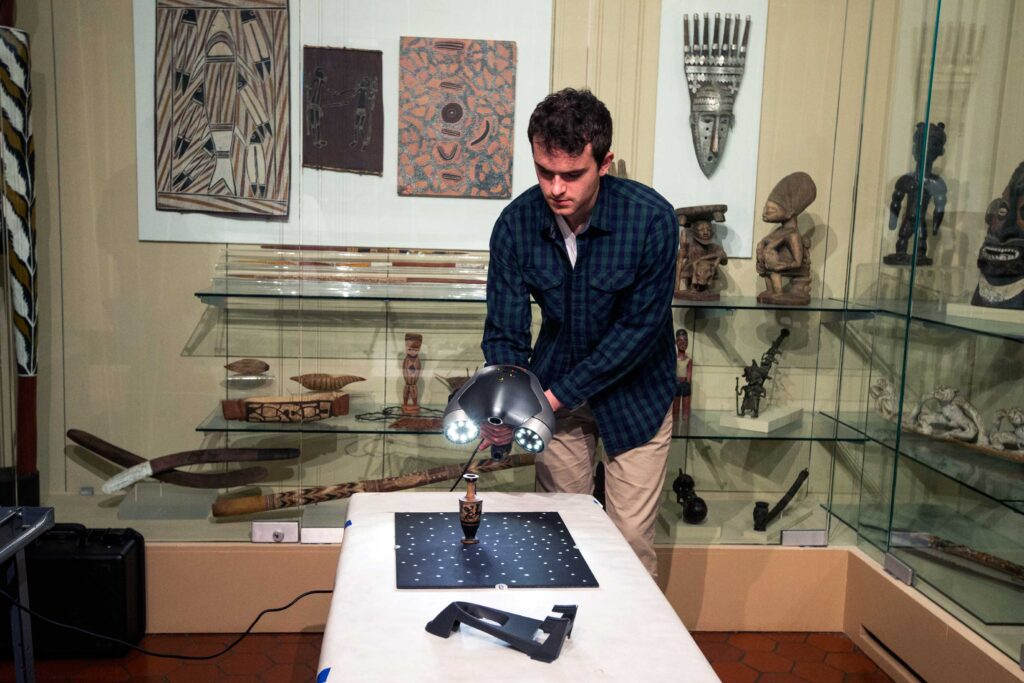
Given the vast quantities of ancient Greek vases surviving, coupled with our attention to their imagery both in scholarship and teaching, it is inevitable that modern focus on them has been more visual than tactile. What if we step back for a moment to ask:
- What were Greek vases?
- Who made them?
- Who used them, where, and why?
It seems obvious that we have, perhaps through no fault of our own, spent too much time looking at them and not enough time holding them. In the short term this can be addressed through projects like 3D-GV, which combines traditional methods of Greek pottery analysis with rapidly evolving digital technologies. From the start, our primary goal was to create scale-replicas of inaccessible ancient objects for use in the local classroom, and to make the digital data available through open access. Both goals have been achieved. The models have been used in several departments at UVA as a pedagogical tool, though in very different ways. Students in my Greek Art lecture courses volunteer to wear a blindfold while handling a plastic pyxis, lekythos, or hydria (fig. 6), while playing a game of 20 Questions with their peers: “Is it an open or closed vessel?”, “Does it have on offset neck?”, “What is its estimated capacity?” Students in Digital Archaeology have used our computer models to compare laser scanning with photogrammetry with regards to both form and decoration.
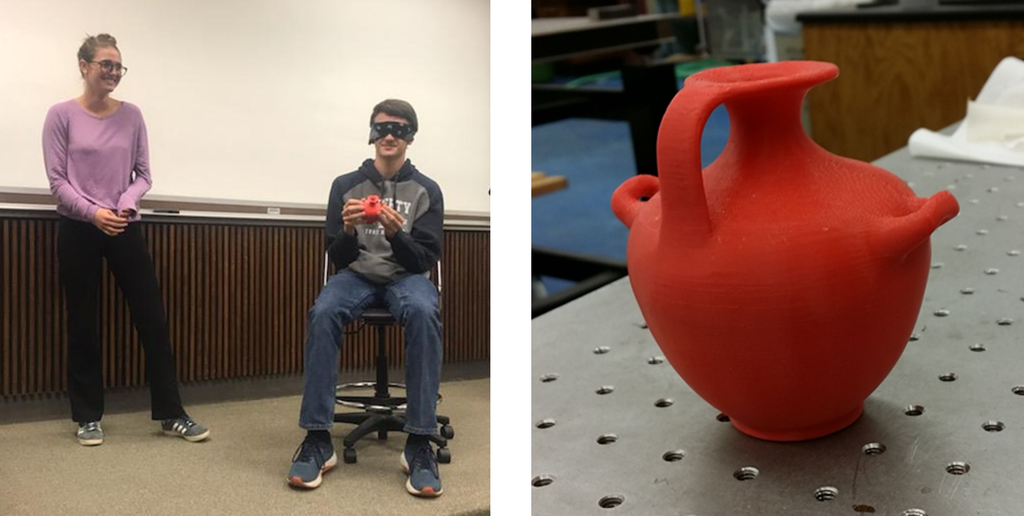
Beyond UVA, our 3D Greek vase data have been put to the test in versatile environments, including museum exhibits, digital archaeology workshops, outreach events, and numerous university classrooms. Exposure to these mixed audiences has presented longer term issues to explore. How does scanned data play a role in cultural heritage management and the preservation of the past? How can the act of creating scale models of Greek vases enhance archaeological practice and interpretation (Hostettler et al. 2024)? When touching and handling a 3D-printed vase, how might different materials or weights impact the overall experience? Might there be a more prominent place for Greek vases in K-12 environments and among neurodiverse communities discovering the Classical world (Deacy 2023; cf. Kantaros, Soulis, and Alysandratou 2023)? As we pursue these future avenues and more, let us remember not only to engage the sense of sight when approaching ancient Greek vases, but also the to harness the power of touch as an additional mode of accessing the past.

References:
Deacy, S. (2023). What Would Hercules Do? Lessons for Autistic Children Using Classical Myth. Warsaw: University of Warsaw Press.
Hostettler, M. et al. (eds). (2024). The 3 Dimensions of Digitalised Archaeology: State-of-the-Art, Data Management and Current Challenges in Archaeological 3D-Documentation. Cham: Springer.
Jamil, M.-H. et al. (2018). “The Role of Haptics in Digital Archaeology and Heritage Recording Processes,” 2018 IEEE International Symposium on Haptic, Audio and Visual Environments and Games (HAVE), Dalian, China, 2018: 1-6.
Kantaros, A., Soulis, E. and Alysandratou, E. (2023). “Digitization of Ancient Artefacts and Fabrication of Sustainable 3D-Printed Replicas for Intended Use by Visitors with Disabilities: The Case of Piraeus Archaeological Museum,” Sustainability 15, no. 17: 12689.
Malafouris, L. and Koukouti, M.-D. (2022). “Where the Touching is Touched: The Role of Haptic Attentive Unity in the Dialogue between Maker and Material,” Multimodality and Society 2: 265-287.
Purves, A.C., ed. (2017). Touch and the Ancient Senses: The Senses in Antiquity. London/New York: Routledge.