
Using our Search
Ways to Search
Search using the bar on our Homepage or Search page if you know what specific concept you’re looking for (e.g. “column krater,” “Kleophrades,” “Geometric”).
On our Search page, click the “Filters” drop-down to refine your search by Concept Type or to Sort your results. Under “Concept Type,” you will find a variety of options:
Person (refined by Class, Group, Painter, and Potter)
Legal Body (museums and collections)
Period
Place
Material
Group
Shape
Style
Technique
Ware
Role (definitions for Class, Group, Painter, and Potter)
For more on how we define these terms, see Our Terminology.
3. Browse
Browse using the “Browse by Category” function on our Homepage if you’re not searching for something specific. This kind of search will generate a comprehensive list of results ordered alphabetically.
Understanding Results
After your search, your results will be generated with a short preview displaying the Term, Definition, and Type. Click on the Term to view the full record.
Basic Information
On the record page, you will be presented with a wide variety of information. What follows below is an explanation of the most essential information generated on these pages.
Let’s take the page for “Aryballos” as an example:
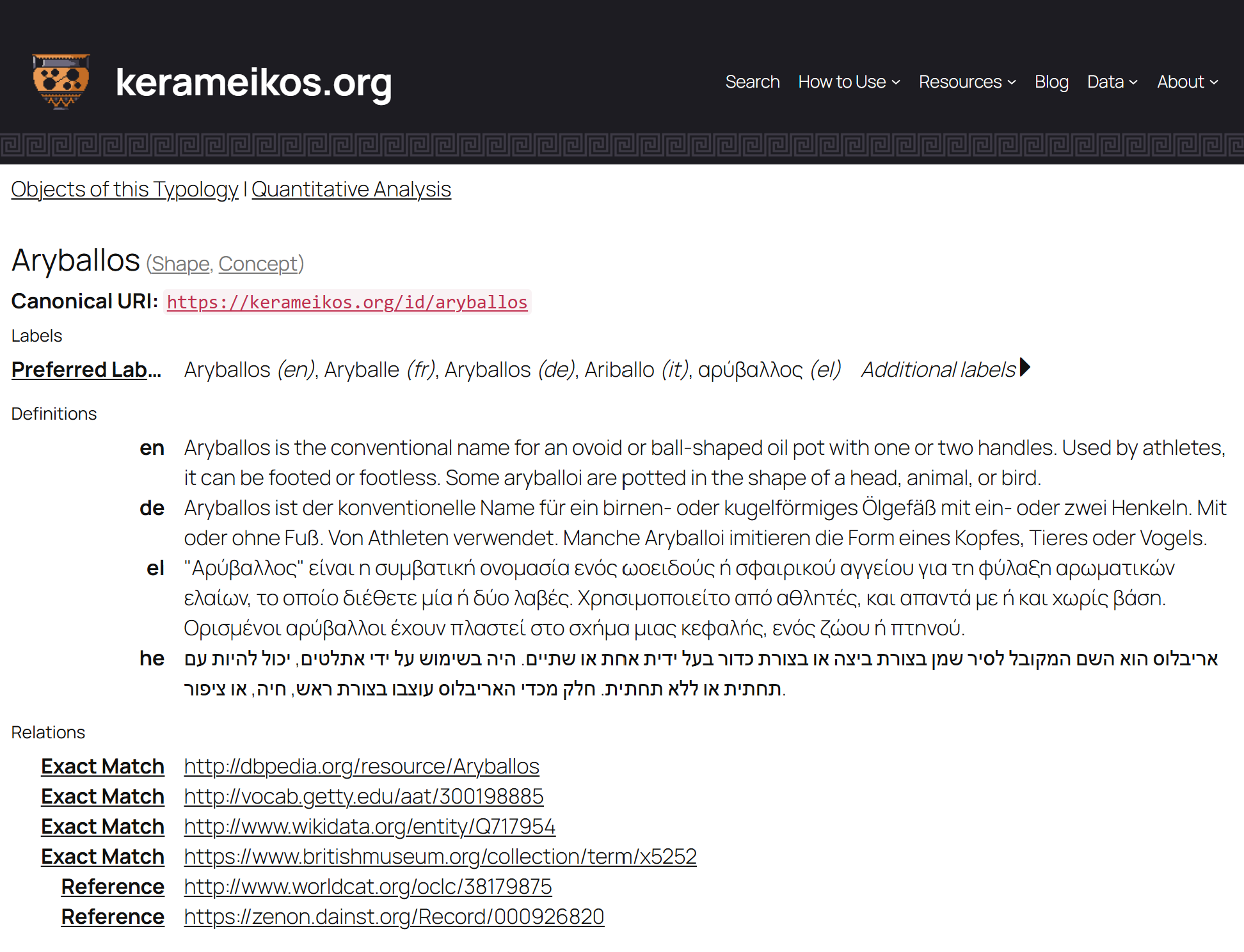
The Canonical URI refers to the stable link for the record page.
Preferred Labels shows the translation of your searched term in multiple different languages.
Under Definitions, you will find the definition for the term in various languages. All of our definitions are currently available in English – if there is a term that is not available into your preferred language, please know that we are actively working on translating our content!
Under Relations, you will find some of the museums and collections that also have LOD entries for that term — they are designated with the label “Exact Match.” You can also see which resources we used to write our definitions with the links labeled “Reference” — in the case of the aryballos, by following these links you can see that we utilized Schreiber’s Athenian Vase Construction (1999) and Sparkes’ Greek Pottery: An Introduction (1991).
Objects and Typological Distribution
Below basic information, you will find data for specific objects related to your search. For the aryballos, a map is generated pinpointing the primary Place the shape is produced (Athens and Corinth) and various Findspots related to particular objects housed in our collaborating museums and collections using LOD.
You can scroll in and out of the map to focus on particular locations, and when clicking specific Places and Findspots, a pop-up box will tell you how many objects are associated with that particular location.
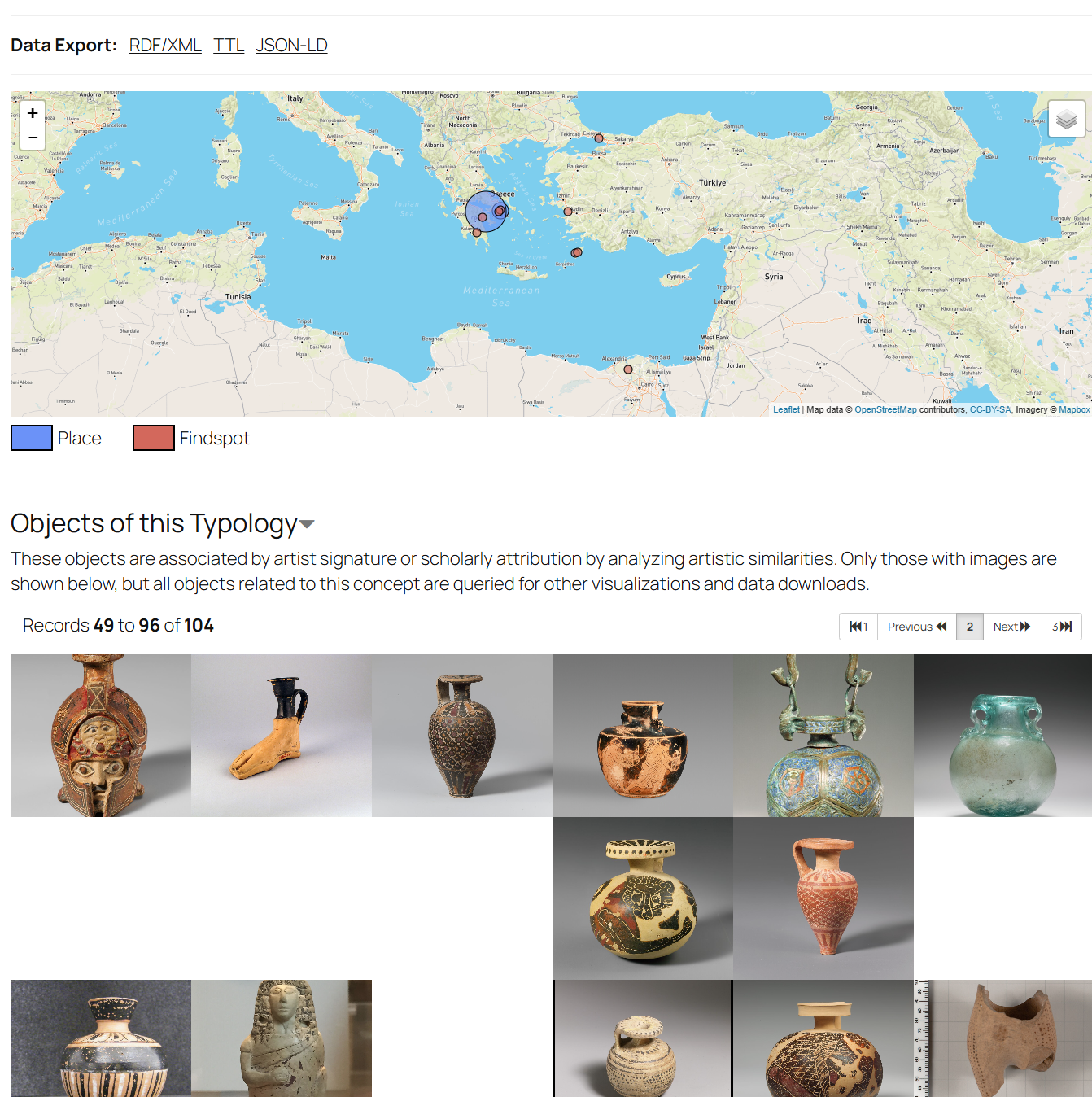
Under “Objects of this Typology” you will find results for specific objects housed in our collaborating museums and collections. By clicking these thumbnails you can enlarge the image and follow the hyperlink to the associated collection entry on the institution’s website.
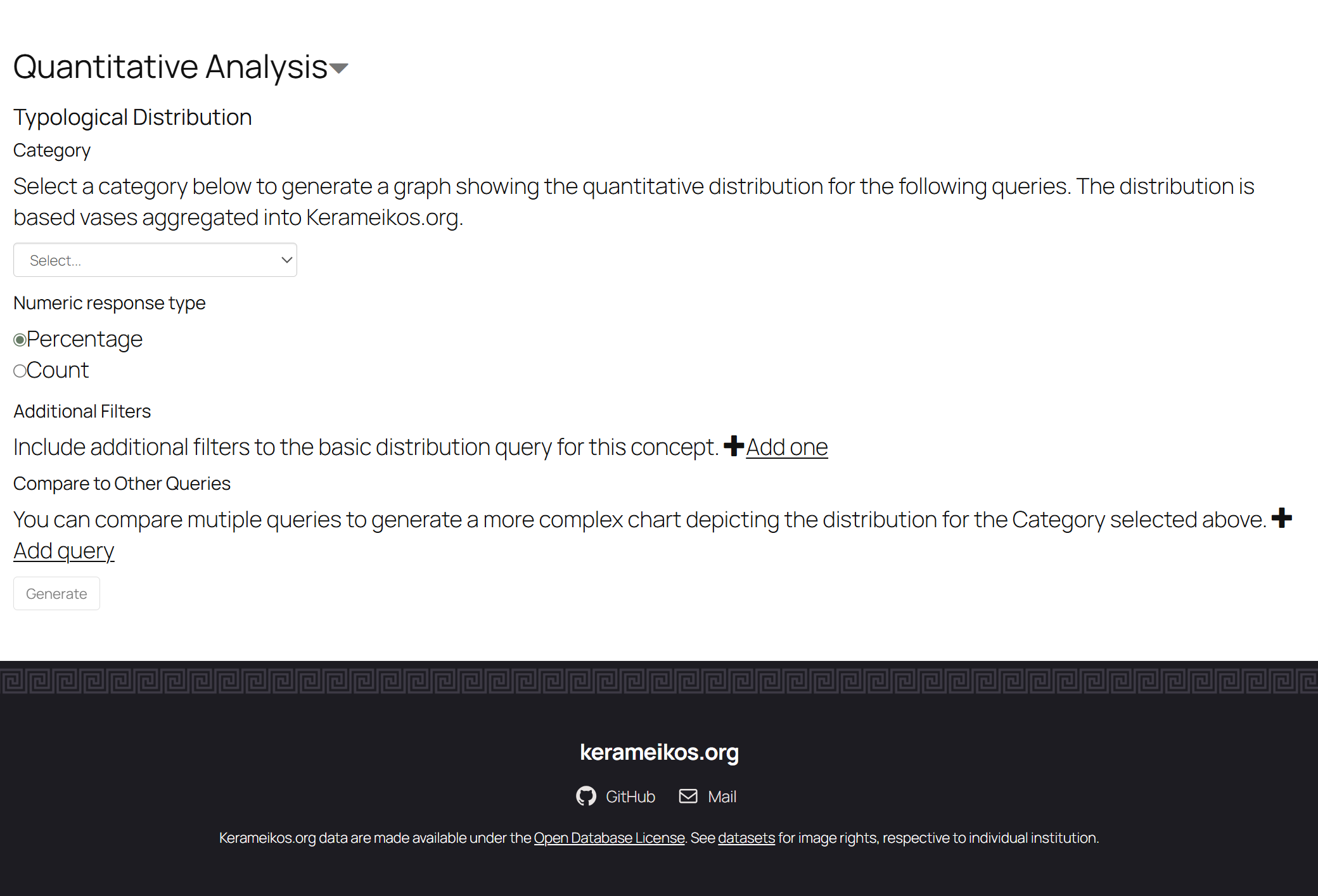
Quantitative Analysis
You can generate graphs and download data using the “Quantitative Analysis” feature. Select a category using the drop-down bar — for example, you can download data about all of the different Production Places for aryballoi by Percentage or Total Count.