

An Amazon warrior holds a horn to her lips, signaling to her comrades that the time has come to pick up arms (fig. 1). Swords and shields scatter the ground, and another warrior bends down to equip herself for battle.
The horn the Amazon plays is called a salpinx, a long trumpet-like instrument played mainly by warriors and heralds in Athenian vase-painting. Though physical remains of the salpinx are scarce in the archaeological record, a reconstruction of a rare example from Olympia provides an opportunity to hear the instrument as it may have sounded in antiquity. In case there was any doubt, the painter of our Amazon warrior tells us exactly what sound the instrument made: an inscription surrounding the Amazon reads “TOTE TOTOTE,” or toot toot toot (Pöhlmann and West 2001, 8; cf. Bélis 1984).
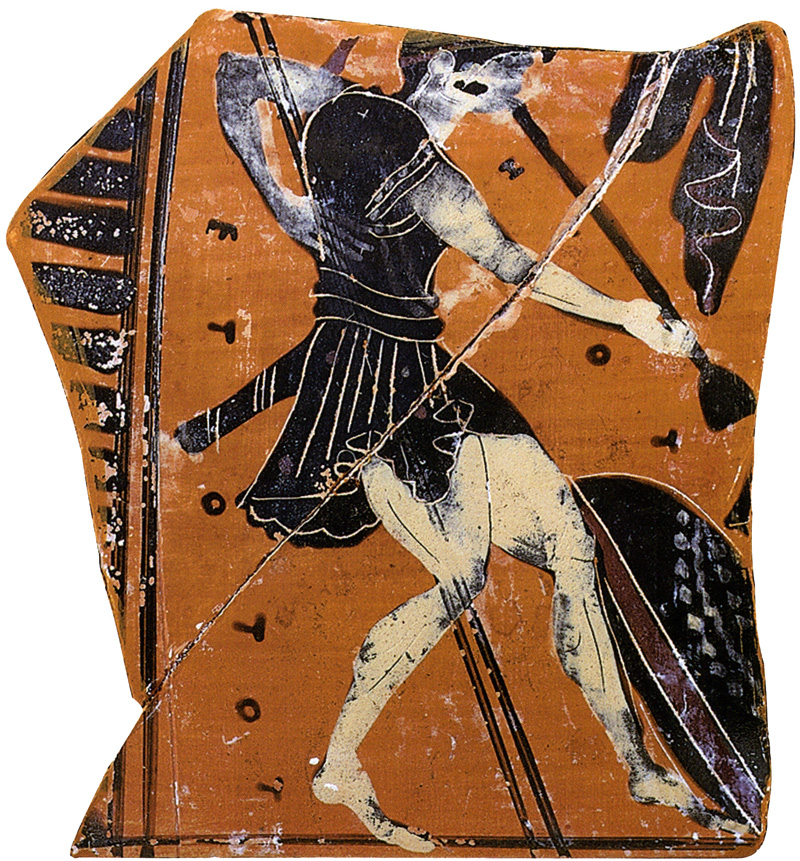
fig. 1: Amazon with salpinx, her playing indicated by the inscription “TOTE TOTOTE”
Athenian black-figure epinetron fragment attributed to the Sappho Painter, ca. 500 BCE (Eleusis, Archaeological Museum 907; BAPD 7965)
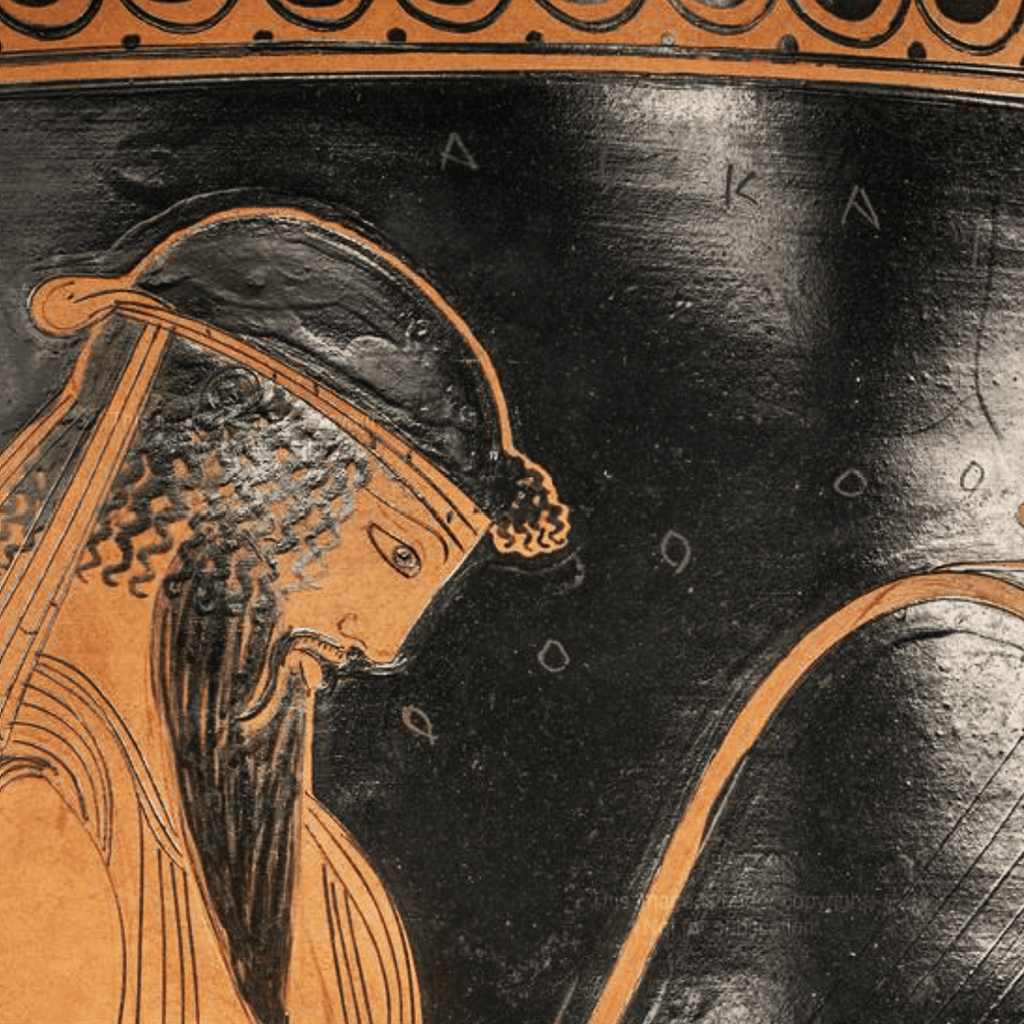
Several onomatopoeic vases like the one above survive from antiquity. A red-figure psykter-kalathos shows the poets Sappho and Alkaios holding barbitoi, Alkaios’ singing represented not only by his slightly parted mouth but also the series of “OOO”s emanating from his lips (figs. 2a–b; Yatromanolakis 2016, 33). From the mouth of an elderly poet on a white-ground mastoid skyphos flows a series of nonsense letters approximating “ηηλολο λοινοχνι” (eelolo loinochnee), an inscription that James Porter writes “conjures up the very senseless of song… the pleasurable reduction of language to sound and sound effects” (fig. 3; Porter 2014, 24). The acoustic dimension of iconography is a rich and burgeoning field of study, explored in recent works including Sylvain Perrot’s “What Makes an Image Sound? The Ancient Greek Point of View” (2022) and Carolyn Laferrière’s Divine Music in Archaic and Classical Greek Art: Seeing the Songs of the Gods (especially her chapter “Painting with Music,” 2024).
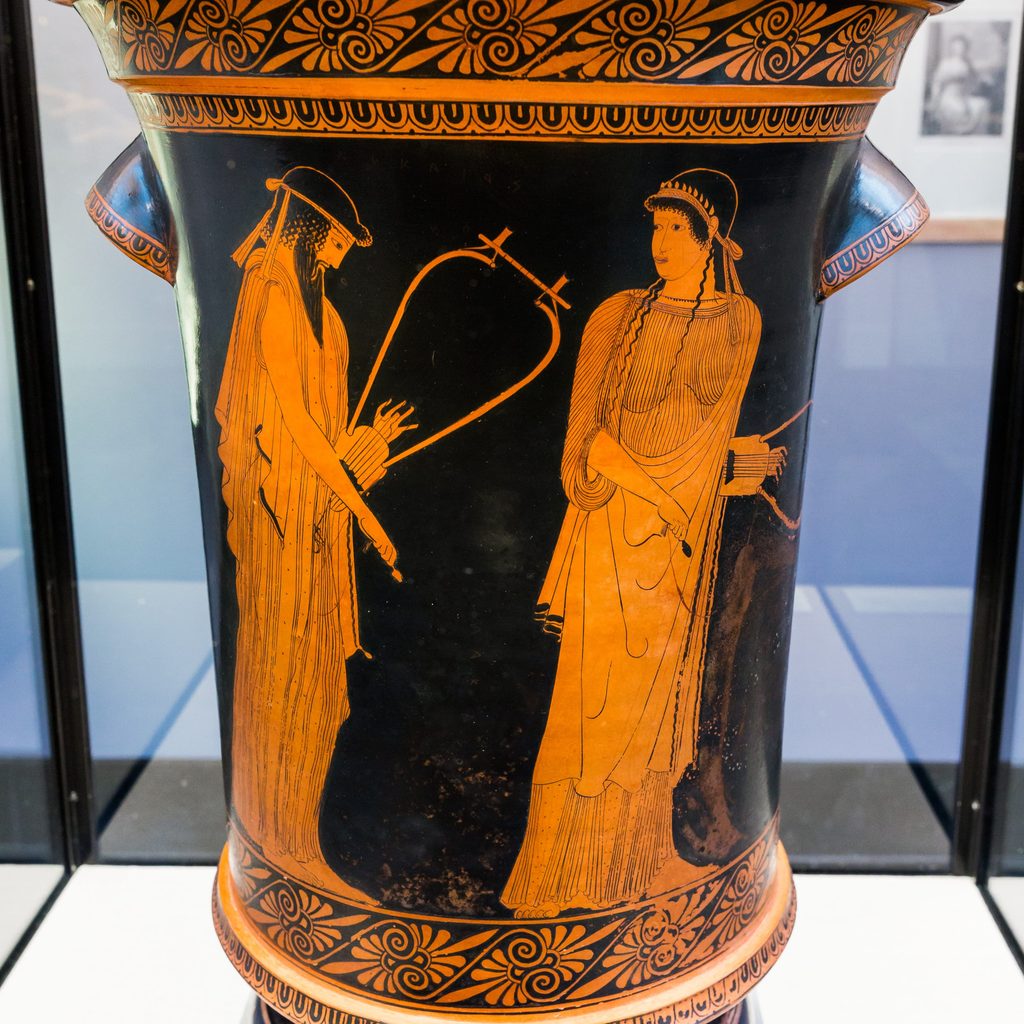
Athenian red-figure psykter kalathos attributed to the Dokimasia Painter, ca. 470 BCE (Munich, Antikensammlungen 2416; ARV² 1573; BAPD 204129)
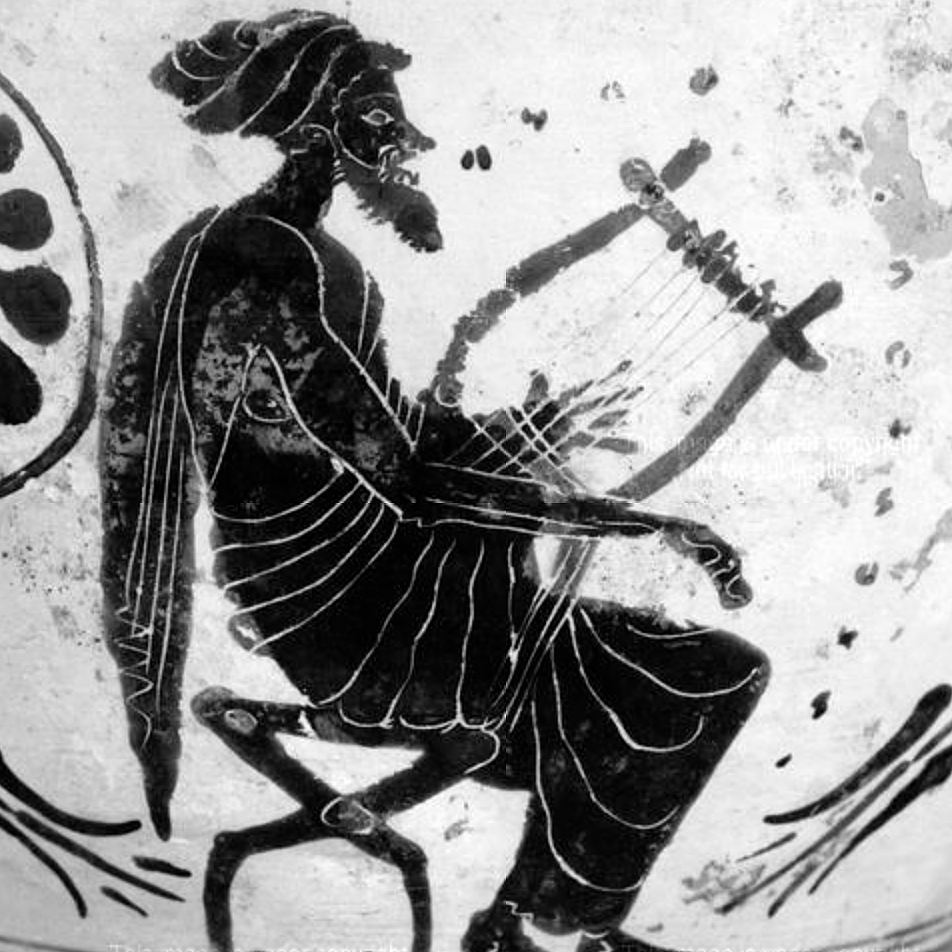
Athenian white-ground footed mastoid skyphos attributed to the Painter from Pistias Class “M,” ca. 515 BCE (Madison, Chazen Museum of Art 1979.122; BAPD 5153)
In addition to musical images, Greek vases themselves were surrounded by a world of sound in antiquity. The noises associated with eating and drinking, especially at the symposion, are perhaps the first that come to mind: the slosh of liquid as water and wine are mixed, the gentle splash as a cup is filled, the growing laughter as cup after cup is drained, the reedy tones of the aulos. The two singing poets above both adorn sympotic vessels: Sappho and Alkaios on an unusual shape called a psykter-kalathos (a vessel used for cooling wine that took the silhouette of a basket), and the old poet on a mastoid skyphos (a cup that, as the name implies, took the form of a woman’s breast). For a party-goer, the images of these silent poets might have been activated by the actual singing of their compatriots, whose poetic recitations would no doubt have grown louder and louder as the evening wore on.
A consideration of the sounds evoked by musical images and their acoustic environments transforms vases from simple objets d’art into facilitators of experience. What memories might a painted image of a kitharode recall during the season of the Panathenaia? What relationships might have been forged over a shared cup of wine, a discussion of a favorite piece by Alkaios prompted by an image of the singing poet? What laughter might have erupted as symposion-goers watched their friend take a deep drink from a breast-shaped cup, their own drunken utterances mirroring the ηηλολο λοινοχνι flowing from the painted poet’s lips?
Our horn-playing Amazon, however, appears on a distinctly non-sympotic shape. She adorns an epinetron, a long, semi-circular cover for the knee and thigh over which wool was drawn to remove dirt. Unlike many sympotic shapes, epinetra were intended to be used primarily by women, and as such are dominated by female imagery: women lounging at home, working wool, making wedding preparations, and, like our Amazon, doing battle (Gilby 2021; Guiraud 1985). The sounds associated with the epinetron’s use are perhaps harder for us to imagine than those of the symposion, which prompts us to consider: what acoustic environments may have existed outside the male-dominated symposion? What sounds and memories might have been evoked by images of women working wool, painted on a shape designed for that very task?
✦✦✦
My aunt is a weaver, and when she works her loom becomes an instrument. Some mornings I will wake to her loom’s rhythmic thumping, the vibrations reverberating through the floorboards and rousing the house from sleep. The rhythm is made up of the soft thump of the wooden pedal being pressed, the corresponding metallic thunk of the shifting frame, the quiet whirr of the shuttle as it is thrown under the shed, and the thud of the beater as the newly-placed weft is packed down.
The percussive capabilities of the loom have recently been explored in a genre we might call “loom music,” an experimental artform pursued by artists like Saba Arat, Patricia Auchterlonie, and Kelly Ruth. Especially pertinent is the work of Phoebe Vlassis, a Greek musician and weaver who sings while working the loom, keeping time with the loom’s characteristic thumps, thunks, whirrs, and thuds. Her music revives weaving work songs, the rhythms and harmonies of which stir something ancient in its listeners and beg them to question why these songs have been so poorly preserved through time. As you continue reading, I invite you to listen to the following song by Vlassis and the Trendafilka ensemble. The song is called Heyamoli, a traditional song from Georgia in the endangered Laz language that roughly translates to:
Let’s say one or two words about your beauty
I’m going to leave my mother and father
And I’ll be yours, yours only
Everyone is satisfied, but you’re not happy
The warp-weighted looms used by ancient Greek women were of course different from the floor loom used by Vlassis, but they were no less acoustic. A study conducted by Magdalena Öhrman at the Centre for Textile Research in Copenhagen in 2018 used experimental methods to examine how Roman poets may have captured the sounds of textile production through sound-mimicking text. Öhrman recorded the sounds of master weavers working on reconstructed warp-weighted looms, a form of loom that changed little (if at all) between its use in ancient Greece and Rome (figs. 4a–b).
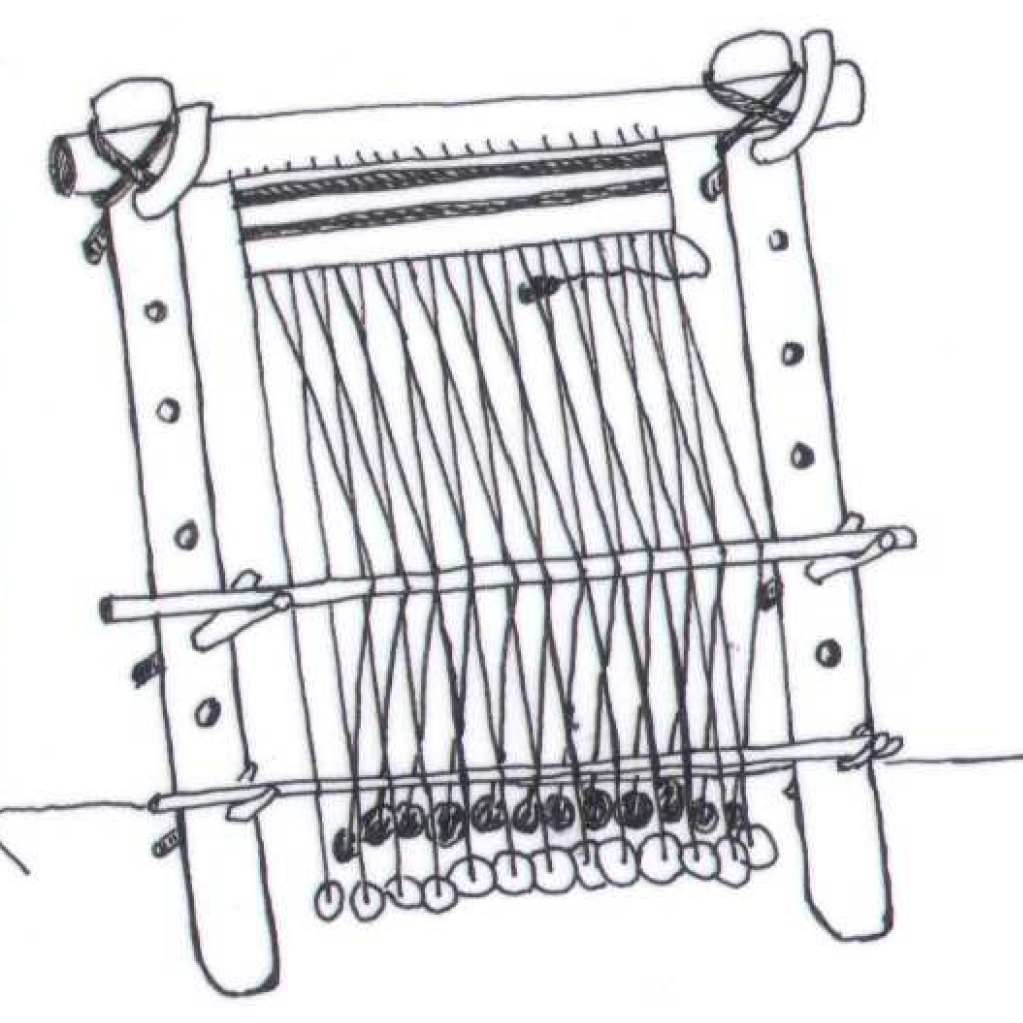
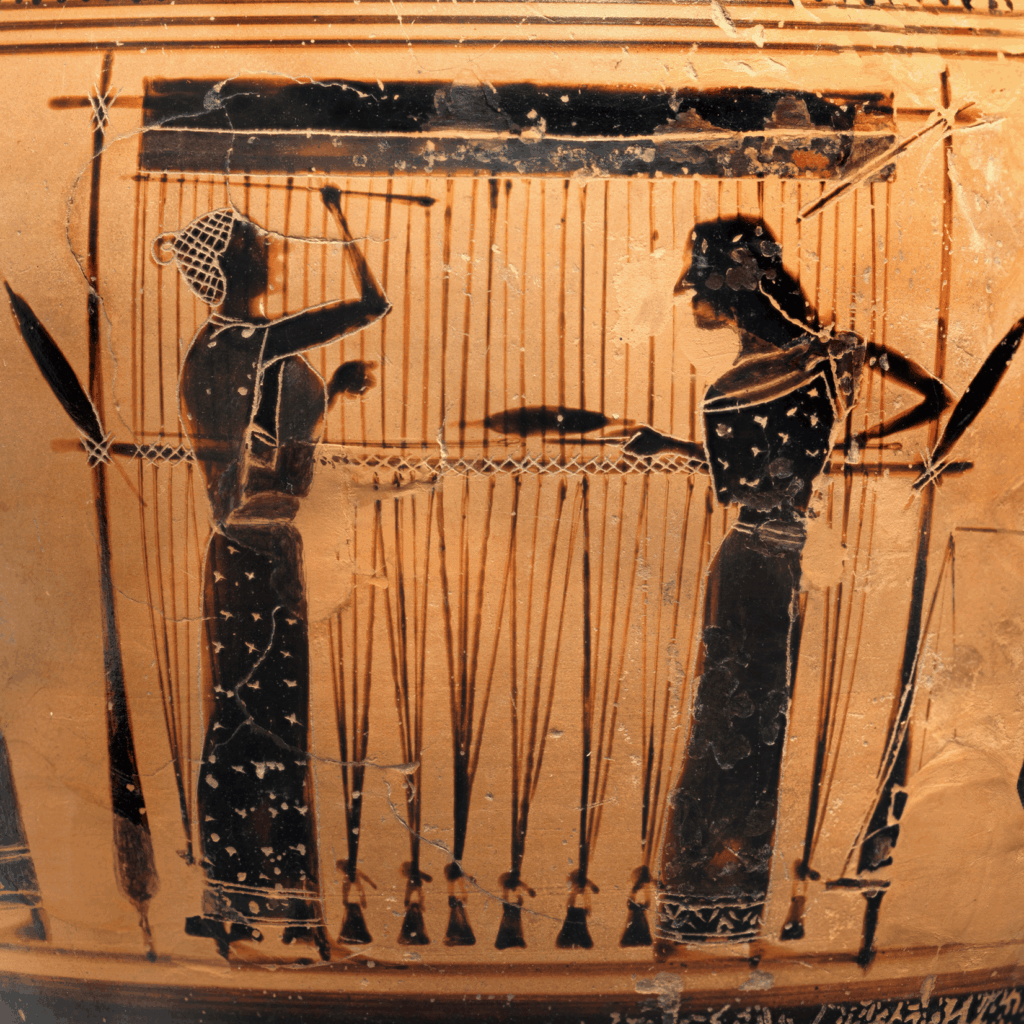
Attic black-figure lekythos attributed to the Amasis Painter, ca. 545–530 BCE (New York, MET 31.11.10; ABV 154.57,688, BAPD 310485)
As the weavers worked, Öhrman identified three types of sound events (2018, 145):
- Beating (weaving sword beating newly inserted weft): sounds are dull and regular, followed by scratching as weaver moves pin beater through warp
- Shed change (moving heddle rods): sounds generated from wooden loom parts moving against one another
- Warp noises: sounds of skin against thread (unsnagging and clearing shed opening) and chiming of ceramic weights as warp threads are shifted
The thumps, scritches, clacks, swishes, and clinks of the warp-weighted loom cycled as the weavers worked, forming a regular rhythmic soundscape captured by Öhrman in the acoustic spectrogram below (fig. 5; 2018, 145). The spikes on the chart indicate the loom’s most intense sounds: the beating (thumps) and shed changes (clacks).

When thinking about the soundscape of ancient Greek weaving, we should also consider the work that preceded the making of fabric itself – carding, spinning, and winding. An epinetron attributed to the Diosphos Painter illustrates such a scene: a pair of women on the right are engaged in conversation while another three work wool, the two on the left gathering wool in baskets while the center figure prepares a distaff for spinning (figs. 6a–b; Guiraud 1985, 46). The women’s interactions with one another, rendered by directed gazes and overlapping hands, makes the viewer wonder what these women might be discussing over the creaking of chairs, the rustling of baskets, the whishing as wool is gathered on distaff.
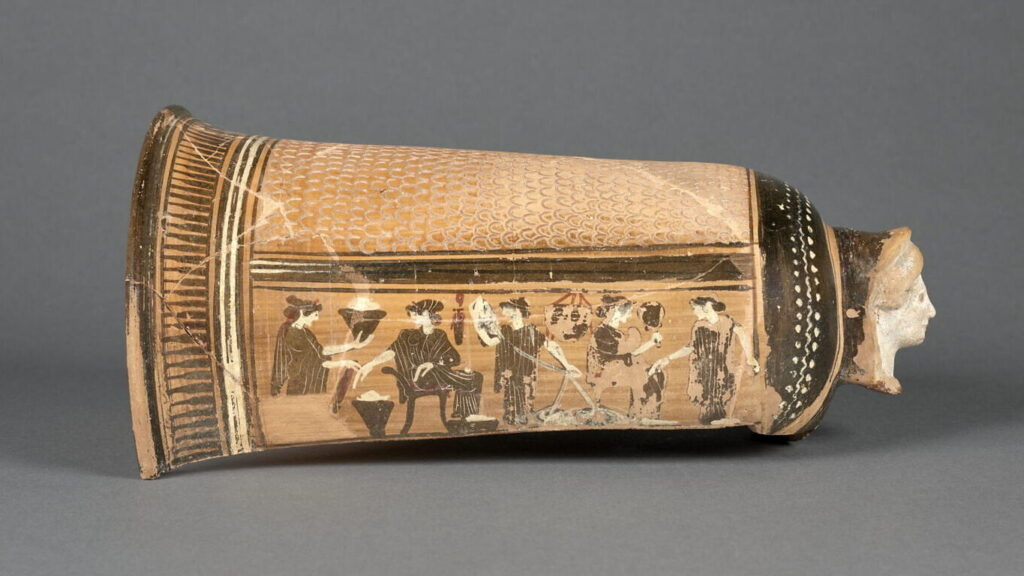
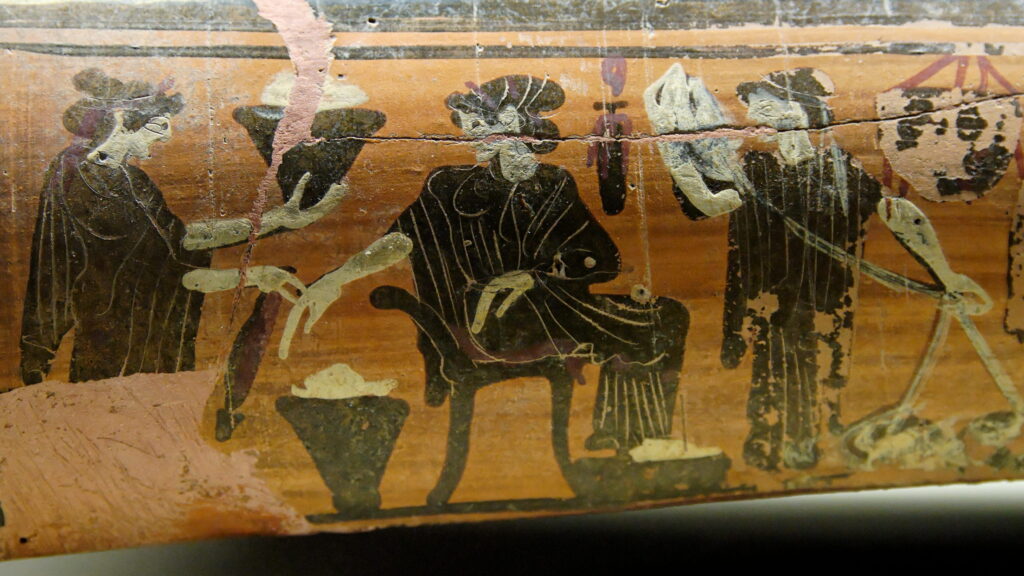
Another acoustic dimension takes shape when considering the physical form of the epinetron itself. The top of the shape is covered with incised scales, providing a rough surface over which wool was pulled to draw out dirt. The sound must have been dry, abrasive, scratching, as fibers caught on the scales and shook loose dirt and debris. Unlike the punctuated rhythms of the loom the epinetron would have been a drone, a sustained hollow sound beneath women’s voices as they spun, wound, and wove. We might begin to envision the sounds of women’s weaving as a type of symphony made up of distinct parts: the loom as the driving rhythm of drums, the epinetron as the sustained drone of low strings, the punctuated percussion of clinking loom weights and rustling baskets, and women’s voices as the melodious tones of woodwinds, their lilting voices (and, as seems likely, their singing) coming together to form a rich tapestry of song.
When I see epinetra and images of women working wool, these are the sounds that play in my mind. I hear these women’s voices, their chattering and singing, their chuckling at the Amazon going toot toot toot on their epinetron, the sounds of their tools, the rhythmic thumping of my aunt’s loom, the haunting harmonies of Vlassis and her ensemble. Vases speak, sometimes literally through inscriptions but more often by drawing upon the viewer’s own experiences, by activating memories of the songs and sounds and noises and rhythms of everyday life. They invite us to come closer, to imagine the sounds that accompanied these scenes and perhaps to recognize something familiar in them. All we need to do is listen.
✦✦✦
For more on experimental reconstructions of ancient weaving see The PENELOPE Project, directed by Ellen Harlizius-Klück. On the role of weaving in ancient Greek storytelling see Heath 2011, Fanfani 2017, and Nosch 2014.
Select Bibliography:
Bélis, A. 1984. “Un nouveau document musical.” Bulletin de Correspondance Hellénique 108 (1): 99–109.
Bundrick, S. 2008 “The Fabric of the City: Imagining Textile Production in Classical Athens.” Hesperia 77 (2008): 283–334.
Dukelsky, C. 2021. “Mujeres griegas en las imágenes de la cerámica: novias, esposas.” Asparkía 39 (2021): 21–41
Fanfani, G. 2017. “Weaving a Song. Convergences in Greek Poetic Imagery between Textile and Musical Terminology. An Overview on Archaic and Classical Literature.” In Textile Terminologies from the Orient to the Mediterranean and Europe, 1000 BC to 1000 AD, edited by S. Gaspa, C. Michel, and M.-L. Nosch, 421–436. Lincoln: Zea Books.
Gilby, D. 2021. “Weaving the Body Politic: The Role of Textile Production in Athenian Democracy as Expressed by the Function of and Imagery on the Éπίνητρον.” Athens Journal of History 7 (3): 185–202.
Guiraud, H. 1985. “La vie quotidienne des femmes à Athènes: à propos de vases attiques du Ve siècle.” Pallas 32: 41–57.
Heath, J. 2011. “Women’s Work: Female Transmission of Mythical Narrative.” Transactions of the American Philological Association 141: 69–104.
Karanika, A. 2014. Voices at Work: Women, Performance, and Labor in Ancient Greece. Baltimore: Johns Hopkins University Press.
Laferrière, C. 2024. Divine Music in Archaic and Classical Greek Art: Seeing the Songs of the Gods. Cambridge: Cambridge University Press.
Nosch, M.-L. 2014. “Voicing the Loom: Women, Weaving, and Plotting.” In KE-RA-ME-JA: Studies Presented to Cynthia W. Shelmerdine, edited by D. Nakassis et al., 91–102. Philadelphia: INSTAP Academic Press.
Öhrman, M. 2020. “The Soundscape of Textile Work in the Roman World: Old Sources and New Methods.” In New Approaches to Ancient Material Culture in the Greek & Roman World, edited by C. Cooper, 183–200. Leiden: Brill.
Öhrman, M. 2018. “The Singing Loom: The Importance of Textile Production in the Roman Domestic Soundscape.” In Archaeoacoustics lll: More on the Archaeology of Sound, edited by L. Eneix and M. Ragussa, 143–150. Myakka City: OTS.
Perrot, S. 2022. “What Makes an Image Sound? The Ancient Greek Point of View.” Music in Art 47 (1/2): 5–22.
Pöhlmann, E. and M. L. West. 2001. Documents of Ancient Greek Music: The Extant Melodies and Fragments. Oxford: Clarendon Press.
Porter, J. 2014. “Why Are There Nine Muses?” In Synaesthesia and the Ancient Senses, edited by S. Butler and A. Purves, 9–26. Abingdon: Routledge.
Yatromanolakis, D. 2016. “Soundscapes (and Two Speaking Lyres).” In Epigraphy of Art: Ancient Greek Vase-Inscriptions and Vase-Paintings, edited by D. Yatromanolakis. Oxford: Archaeopress.