

What is a Greek Vase?
What is a Greek Vase?
The term “Greek vase” refers to the pottery that was produced for and used in nearly all aspects of ancient life — storing oil, drinking wine, performing religious rituals, and more. Though we call them “vases,” Greek ceramic pottery comes in a wide variety of shapes including jars, jugs, cups, mixing bowls, and perfume containers. In antiquity they were practical objects that moved through homes, workshops, sanctuaries, marketplaces, and even graves. Today we appreciate Greek vases as both functional objects and pieces of art.
Greek vases were made from a variety of different clays (called “fabrics”), and most were shaped on a potter’s wheel. All were then fired in a kiln, a multi-staged process through which the chemical structure of the clay itself was irreversibly changed — the clay transformed into terracotta (“fired earth”) and became hard as stone. Though it may be broken into hundreds of pieces (called “sherds”), terracotta itself is virtually indestructible. This durability is why pottery is by far the most abundant material preserved in the archaeological record, and its ubiquity makes them an excellent tool for archaeologists to use in dating ancient material.
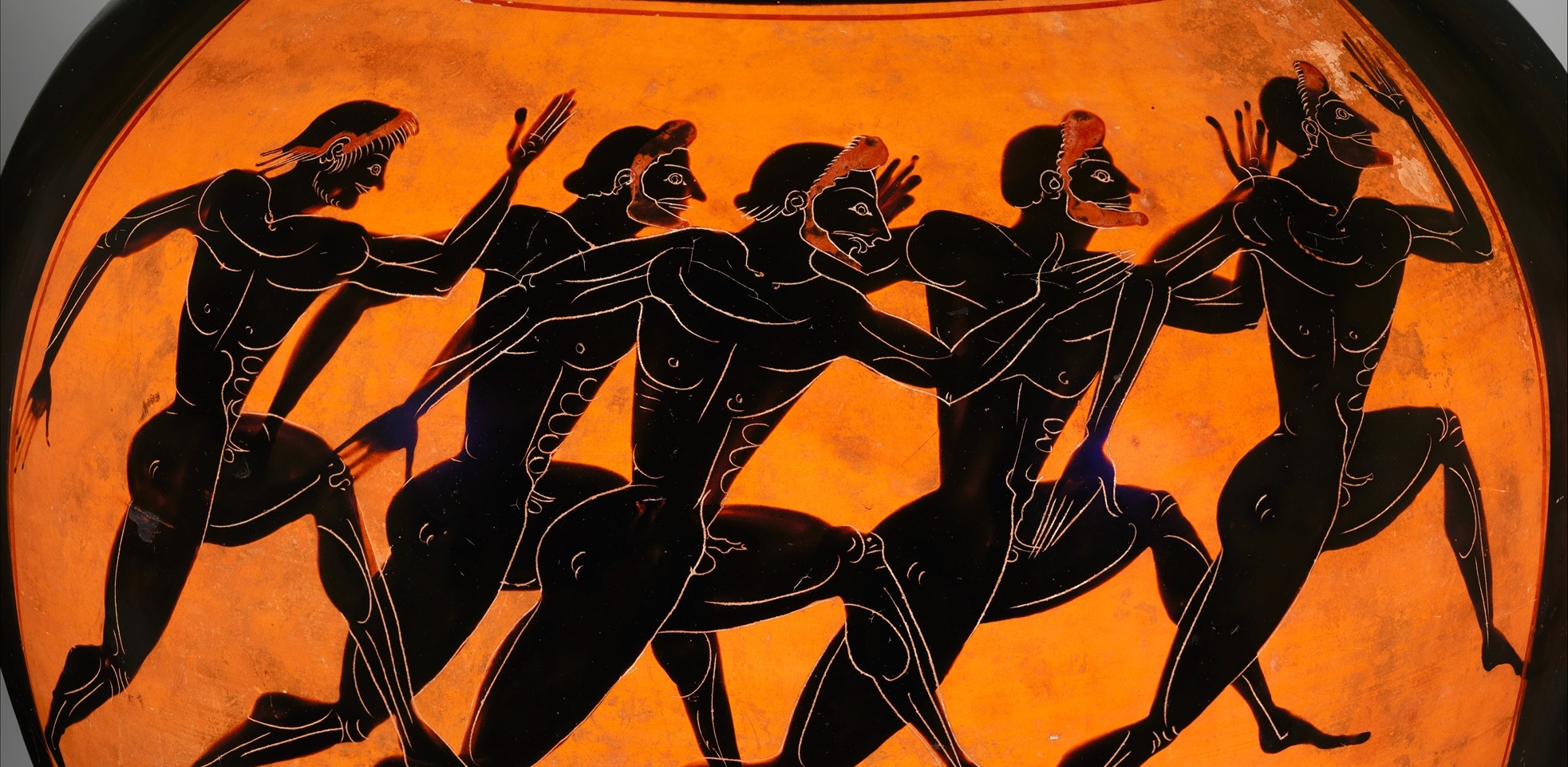
Many Greek vases were decorated with elaborate scenes, and we call this “figure-decorated pottery.” Figure-decorated pottery illustrates not only images of the gods, heroes, and mythology, but also scenes that are sometimes only selectively mentioned in Greek texts, including daily life, religious ritual, athletics, warfare, education, music, and dance. Greek vases can even tell us stories that are completely absent from the literary record, or present well-known myths in new and unfamiliar ways.
Why Vases Matter for Archaeology, History, and Classical Studies
Archaeologists can utilize Greek vases as evidence in nearly all aspects of archaeology, Classics, and ancient history. Vases can be used to:
- Date archaeological contexts based on the style of the associated pottery
- Identify workshops and trade networks by tracing where vases were made and where they ended up
- Reconstruct ancient stories, values, and social practices from painted scenes
- Study ancient craft production, such as kiln technology, workshop organization, and identifying the individual “artists” who worked in the potter’s quarter
Online Resources
Beazley Archive Pottery Database (BAPD)
The BAPD is the world’s largest database of ancient Greek painted pottery. It contains records of more than 130,000 ancient pots and 250,000 images. Nearly all of the pots included were made during the 6th to 4th centuries BCE, and about three quarters of them were made in Athens. This database has its origins in the physical Beazley Archive, which is kept in the Classical Art Research Centre in Oxford.
Corpus Vasorum Antiquorum (CVA) Online
Hosted by the University of Oxford’s Classical Art Research Centre on behalf of the Union Académique Internationale (UAI), the CVA consists of a series of high-quality catalogues of mostly ancient Greek painted pottery in collections around the world. The first fascicule appeared in 1922 and since then more than 400 have been published, illustrating more than 100,000 vases in 24 countries.
Oxford Bibliographies: Greek Vase Painting
A brief introduction to vase studies and a list of general overviews, authored by Tyler Jo Smith. Oxford Bibliographies hosts introductions to a variety of related topics in Classics including Greek history, epigraphy, art, architecture, painting, sculpture, and more.
Panoply Vase Animation Project
The Panoply Vase Animation Project creates animations from real ancient artifacts to help people enjoy and understand ancient cultures and for instructors to use in teaching ancient topics, visual literacy, and how to use artifacts as evidence. In addition to animations, Panoply hosts a variety of other resources including information about vase shapes and educational slides for topics like museum curation and Greek mythology.
WebLIMC
WebLIMC.org is a digital collection of over 50,000 ancient objects, documents, and photographs that were assembled in the course of the preparation of the Lexicon Iconographicum Mythologiae Classicae (LIMC; 1981–1999 and 2009) and the Thesaurus Cultus et Rituum Antiquorum (ThesCRA; 2004–2014). Digital resources are provided by Digital LIMC and LIMC France.
General Bibliography
Bérard, C., et al. 1984. La cité des images: Religion et société en Grèce antique. Paris: Fernand Lathan.
Boardman, J. 2001. The History of Greek Vases. London: Thames and Hudson.
Cook, R. M. 1997. Greek Painted Pottery. 3rd ed. London: Routledge.
Jones, R. 2021. The Decoration and Firing of Ancient Greek Pottery: A Review of Recent Investigations. Advances in Archaeomaterials 2(2): 67–127.
Lissarrague, F. 2001. Greek Vases: The Athenians and Their Images. Edited by B. Eskenazi, translated by K. Allen. New York: Riverside.
Mannack, T. 2012. Griechische Vasenmalerei: Eine Einführung, 2nd ed. Darmstadt and Mainz: Philipp von Zabern.
Noble, J. V. 1966. Techniques of Painted Attic Pottery. Thames and Hudson.
Nørskov, V. 2022. When is a Collection a Collection? Provenance Studies and the Role of Dealers’ Collections. Księgarnia Akademicka.
Oakley, J. H., et al., eds. 1997–2014. Athenian Potters and Painters. Vols. I–III. Oxford: Oxbow Books.
Osborne, R. 2018. The Transformation of Athens: Painted Pottery and the Creation of Classical Greece. Princeton: Princeton University Press.
Robertson, M. 1992. The Art of Vase-Painting in Classical Athens. Cambridge: Cambridge University Press.
Schreiber, T. 1999. Athenian Vase Construction: A Potter’s Analysis. J. Paul Getty Museum.
Sparkes, B. A. 1991. Greek Pottery: An Introduction. Manchester: Manchester University Press.
Sparkes, B. A. 1996. The Red and the Black: Studies in Greek Pottery. London: Routledge.